Have you ever been in a home that seems to maintain a pleasant temperature almost effortlessly — cool on a hot afternoon, warm on a cool evening — without the air conditioning or heating running constantly? And have you been in homes that seem to swing with the weather — heating up rapidly when the sun hits them and cooling quickly after dark?
The difference is almost certainly thermal mass. The ability of a building to store heat and release it slowly — dampening the temperature swings that make Perth homes uncomfortable — is one of the most powerful and misunderstood tools in residential building design. Understanding it is fundamental to understanding why some Perth homes feel effortlessly comfortable and others never do, regardless of how much you spend on air conditioning.
What is thermal mass
and how does it work?
Thermal mass refers to materials within a building that have the ability to absorb, store and slowly release heat energy. When warm sunlight or warm air heats a high-mass element — a concrete floor slab, a brick wall, a stone surface — that element absorbs the heat rather than allowing it to immediately raise the air temperature. Later, as the surrounding temperature drops, the element releases that stored heat slowly back into the space.
This heat-buffering effect dampens the temperature swings within the building — the interior stays cooler during the hottest part of the day and warmer during the coolest part of the night. In Perth's climate, with its significant day-night temperature differential, this is particularly valuable. A day that swings from 35°C to 18°C is exactly the conditions where well-placed thermal mass can eliminate the need for active cooling and heating through the shoulder seasons.
"Thermal mass works like a thermal battery — charging during warm periods and discharging during cool ones. The bigger and better-placed the battery, the more stable the indoor temperature."
The critical rule —
inside the insulation, not outside it
Thermal mass only works to stabilise indoor temperatures if it sits inside the building's insulation envelope. This is the most commonly misunderstood aspect of thermal mass design — and getting it wrong can actually make a building less comfortable rather than more.
A concrete slab that is thermally connected to the outside — through uninsulated edges, or through a building envelope that allows heat to flow freely through it — will simply follow the outdoor temperature rather than buffering the indoor one. The mass needs to be thermally isolated from the outdoor environment so that it can act as a heat reservoir for the interior, not as a thermal connection to outside.
For a Perth home on a concrete slab, this means insulating the slab edges and, ideally, adding under-slab insulation — a detail that is still uncommon in standard Perth construction but makes a significant difference to thermal performance, particularly in the Perth Hills where ground temperatures are lower.
The limitation of thermal mass
in lightweight construction
The challenge for many Perth homes — particularly lightweight timber-framed homes, which are increasingly common — is that they have limited thermal mass. A timber-framed home with no concrete slab, plasterboard walls and a suspended timber floor has almost no capacity to store heat. These homes heat up and cool down rapidly, and feel responsive to the weather in an uncomfortable way.
Adding thermal mass to a lightweight home is not straightforward. A concrete slab on a lightweight home is structurally problematic. Brick feature walls or rammed earth walls are possible in new builds but costly and difficult to retrofit. For years, this left owners of lightweight homes with limited options — accept the temperature swings or run mechanical systems continuously.
This is where an emerging technology — phase change materials — opens up genuinely new possibilities.
Phase change materials —
the next generation of thermal mass
Phase change materials (PCMs) are substances that absorb and store large quantities of heat energy when they change from solid to liquid at a specific temperature — and release that same energy back when they return to solid. The key insight is that the phase change process itself absorbs and releases far more energy than simply heating or cooling a solid material like concrete.
For building applications, PCMs are typically formulated to change phase at a temperature close to the desired indoor comfort range — around 23°C. During a warm Perth afternoon, as the indoor temperature rises toward and above 23°C, the PCM absorbs heat and changes phase from solid to liquid — effectively acting as a heat sponge that prevents the temperature from rising further. As the evening cools, the PCM releases that stored heat and returns to solid — warming the space gently through the night.
Traditional Thermal Mass
- Concrete, brick, stone — common and well understood
- High volume required for significant heat storage
- Adds structural weight — challenging in lightweight construction
- Effective but bulky — requires design from the ground up
- Heat release is gradual but gets cold as it releases
- Cannot easily be retrofitted into existing homes
Phase Change Materials
- Absorbs and releases heat at a specific comfort temperature (~23°C)
- Stores 5–14× more heat per unit volume than concrete
- Lightweight — can be incorporated into wallboard or ceiling panels
- Suitable for lightweight timber-framed homes
- Releases heat without getting cold — maintains comfort temperature
- Can be retrofitted into existing homes as upgraded linings
The practical implication is significant: a PCM-enhanced wallboard or ceiling panel can provide the thermal buffering effect of a much heavier concrete or masonry element — in a lightweight form that can be incorporated into a timber-framed home or retrofitted into an existing building. This opens up the benefits of thermal mass design to a far wider range of Perth home types.
How to get thermal mass
right in your Perth home
Expose the slab inside
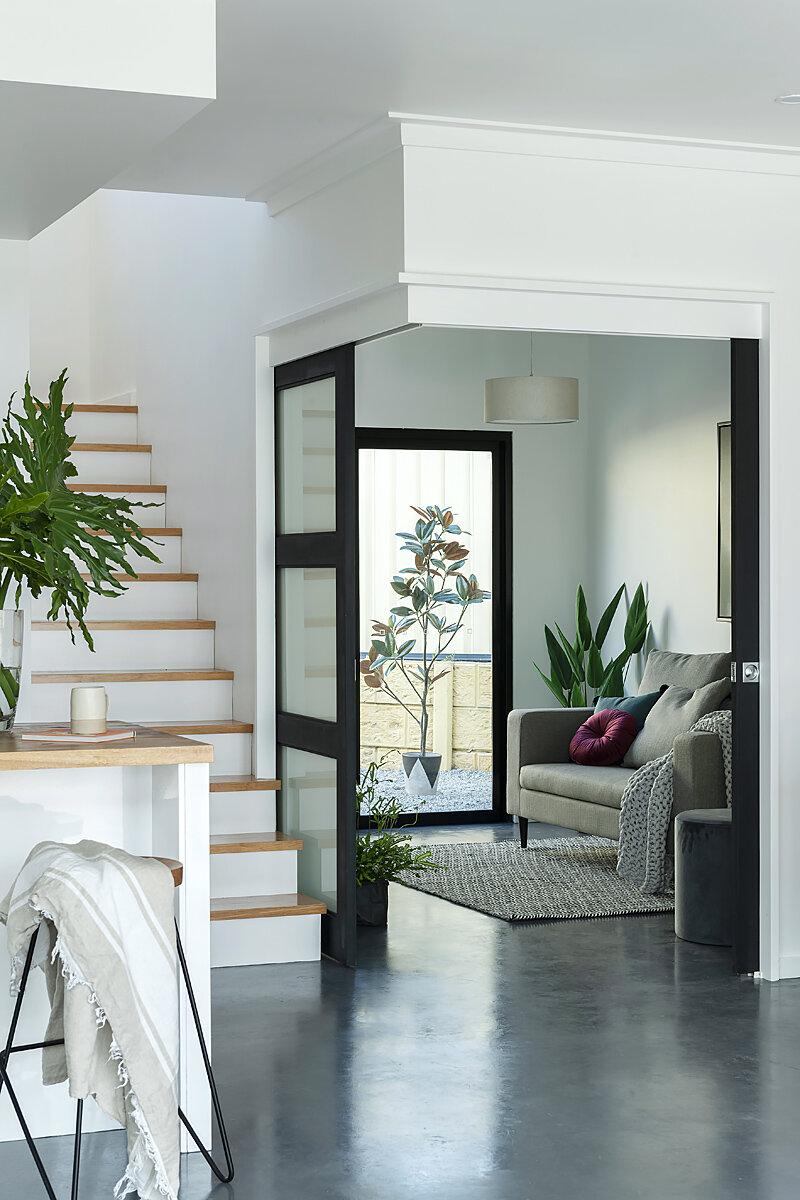
A concrete slab exposed as the finished floor surface has excellent thermal mass. Covering it with carpet or timber flooring significantly reduces its thermal effectiveness. Polished concrete, tiles or stone over slab maximise the thermal mass benefit — and work particularly well with underfloor heating.
Insulate the slab edges
Without edge insulation, a concrete slab is thermally connected to the outside air and ground at its perimeter — dramatically reducing its effectiveness as indoor thermal mass. Edge insulation is a low-cost addition in a new build that significantly improves thermal performance.
Position mass to receive winter sun
Thermal mass is most effective when it can absorb direct solar radiation in winter — a north-facing slab or wall in Perth receives low-angle winter sun and stores it for evening release. South-facing mass receives no direct sun and acts as a heat sink rather than a heat store.
Consider PCMs for lightweight homes
If you are building in lightweight construction or retrofitting an existing home, PCM-enhanced linings or panels can provide thermal buffering that would otherwise require structural changes. Specify PCMs with a phase change temperature close to your desired comfort temperature — typically 21–24°C for Perth.
Thermal mass and Perth's
shoulder seasons
Perth's climate creates a specific opportunity for thermal mass design that is worth understanding. The city's spring and autumn shoulder seasons — September to November, and March to May — have warm days and cool nights, with the day-night temperature differential often exceeding 15°C. This is almost ideal for passive thermal mass performance.
In a well-designed home with good thermal mass, these shoulder season conditions can be managed almost entirely passively — the mass absorbs heat during the day, preventing overheating, and releases it at night, maintaining comfortable temperatures without active heating or cooling. The Aughton House in Bayswater uses its concrete slab, strategic north orientation and passive solar design to extend this passive comfort window significantly — reducing the period when active mechanical systems are needed.
Summer in Perth is a different challenge — temperatures are high enough and sustained enough that thermal mass alone cannot prevent overheating, and shading becomes the primary defence against heat gain. But even in summer, thermal mass helps by slowing the rate at which a well-shaded home heats up through the day, meaning mechanical cooling can run for shorter periods and at lower intensities.
The integrated picture: Thermal mass does not work in isolation. It works best as part of an integrated design strategy — combined with good passive solar orientation to charge the mass in winter, good shading to prevent overheating in summer, good insulation to retain the stored heat, and good airtightness to prevent it from escaping through uncontrolled air leakage.
Each of these elements reinforces the others. This is why Studio Origami designs every project as a complete thermal system — not as a collection of individual features — and why our homes consistently outperform their specification on paper.