
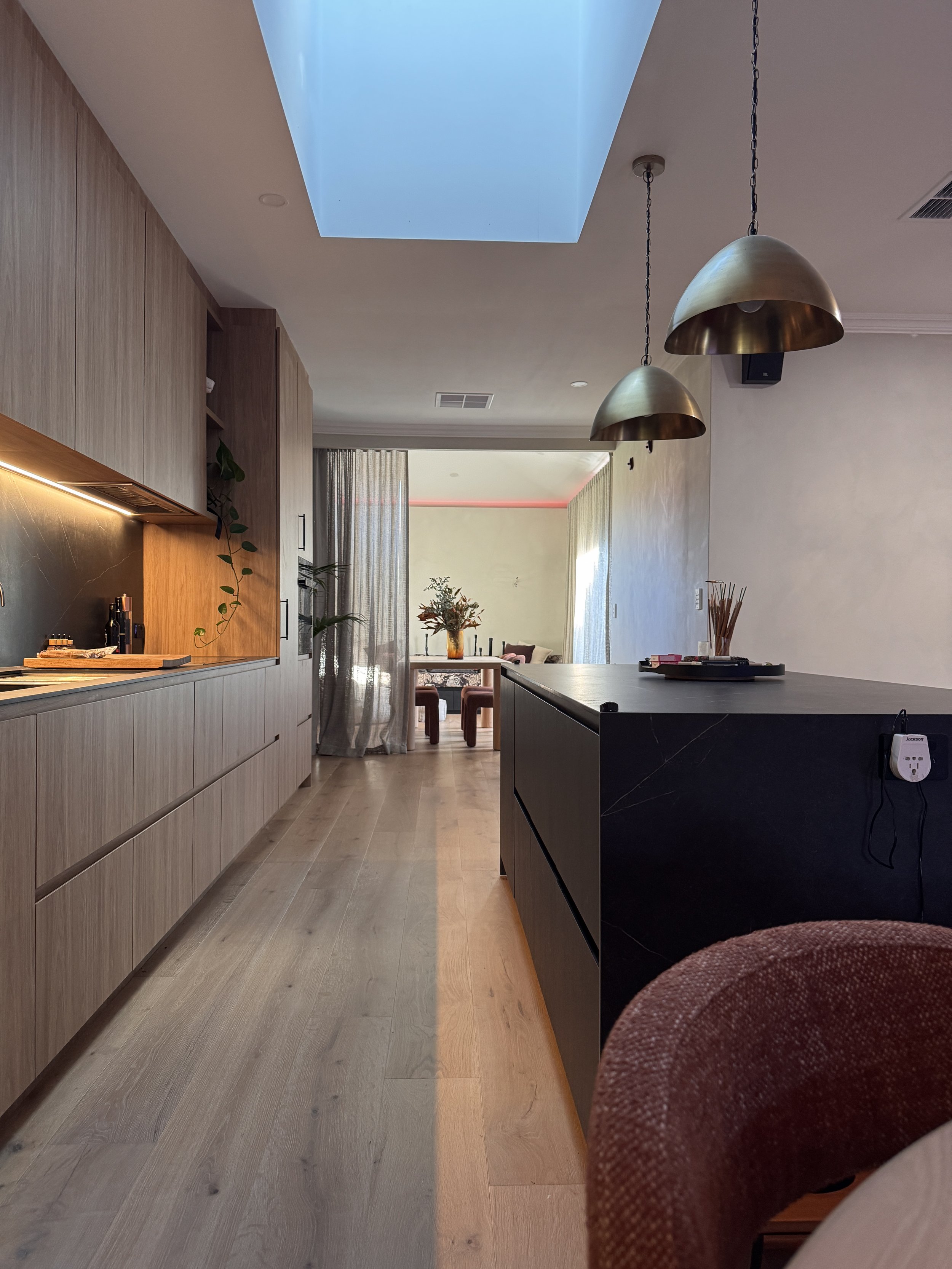
You spend roughly 90% of your time indoors. The air you breathe, the light you're exposed to, the temperature your body maintains throughout the day and night, the materials you touch and live among — all of these have measurable, documented effects on your health, your sleep, your cognitive performance and your long-term wellbeing.
Biohacking your home means designing those elements intentionally — rather than accepting whatever a standard house happens to deliver. It is the intersection of building science, environmental health research and thoughtful design. And in Perth's climate, with our long indoor summers and the increasing density of our inner suburbs, it has never been more relevant.
At Studio Origami, we call this healthy home design. We are the only Perth practice combining certified Passive House building science with intentional healthy home biohacking design — layering performance and biology to create homes that actively support the people living inside them.
Here are the five elements that make the most meaningful difference.
The five elements of
a biohacked home
Indoor Air Quality
Continuous fresh filtered air via HRV or ERV — removing CO₂, allergens, dust and moisture while maintaining comfortable temperatures year-round.
Circadian Lighting
Light that works with your body clock — bright and energising in the morning, warm and low-Kelvin in the evening to support natural melatonin production.
Non-Toxic Materials
Natural timbers, lime-based paints, organic textiles — eliminating the VOCs that off-gas from synthetic building products and accumulate in poorly ventilated homes.
Thermal Comfort
Consistent indoor temperatures year-round — eliminating the hot rooms, cold drafts and temperature swings that put physiological stress on your nervous system.
Nervous System Design
Ceiling heights, natural light, connection to trees and garden, acoustic calm — the spatial qualities that reduce cortisol, support recovery and make a home feel genuinely restorative rather than just visually appealing.
Air quality — the invisible
foundation of health in Perth
Most Perth homeowners have no idea how poor their indoor air quality is. In a standard Perth home, ventilation relies on opening windows — which means during Perth's long, hot summers when windows stay closed against the heat, the air inside becomes progressively stale, CO₂-rich and allergen-loaded. Studies consistently show that indoor air can be two to five times more polluted than outdoor air.
This matters more than most people appreciate. Elevated CO₂ concentrations — even at the levels common in a closed bedroom overnight — measurably impair sleep quality, cognitive function and concentration the following day. For families with young children, people with asthma or allergies, or anyone working from home, the air quality in their house directly affects their daily performance.
A home built with heat recovery ventilation (HRV) or energy recovery ventilation (ERV) continuously cycles fresh, filtered outdoor air throughout the building while recovering the energy from the outgoing air. The indoor air always smells clean. CO₂ levels stay low. Humidity is controlled. And unlike opening windows, it works equally well whether it's 40°C outside or 8°C.
"Clients who move from a standard Perth home into a well-ventilated, airtight home almost always mention the air first. It feels cleaner, calmer, easier to breathe — before they even notice the temperature."
Circadian lighting — designing
for your body clock
Light is the single most powerful regulator of the human circadian rhythm — the 24-hour biological cycle governing sleep, hormone production, metabolism and mood. Yet almost no Perth homes are designed with any consideration for how light affects biology. The result is spaces that work against us: bright LED downlights in the evening suppressing melatonin, poor natural light in bedrooms making mornings harder, no warm lighting to signal to the body that it's time to wind down.
In a biohacked home, the lighting strategy is designed in two modes. During the day, spaces are bright and naturally lit — generous glazing brings in daylight without causing glare or heat gain, and morning rooms face east to capture the energising quality of morning light. In the evening, the lighting shifts: warm, low-Kelvin lamps and indirect lighting replace overhead downlights, supporting the body's natural preparation for sleep.
This doesn't require expensive smart home systems or complicated technology. It requires thoughtful decisions made at the planning stage — the right fixture types, the right colour temperatures, and the right switching zones established before the walls are plastered. Getting it right costs nothing extra if it's designed in from the beginning. Retrofitting it costs significantly more.
Non-toxic materials —
what your home is made of
Every surface in your home is in constant contact with the air you breathe. Many conventional building materials — synthetic carpet, certain paints and primers, MDF cabinetry, vinyl flooring, construction adhesives — off-gas volatile organic compounds (VOCs) that have been linked to respiratory irritation, hormone disruption and neurological effects. In a poorly ventilated home, these compounds accumulate.
The solution is not avoiding all manufactured products — it is making considered choices where it matters most. Natural timber flooring and cabinetry, lime-based paints like Bauwerk Colour, organic textiles, low-VOC adhesives and sealants, and natural stone or recycled glass benchtops all significantly reduce the indoor chemical load. These materials also have a sensory richness — the warmth of timber, the texture of stone, the softness of natural wool — that synthetic materials cannot replicate.
On the Aughton House in Bayswater, local Marri timber benchtops, a recycled glass tile splashback and bamboo flooring were selected for both their environmental credentials and their health properties — an example of how ethical material choices and beautiful design reinforce each other rather than competing.
Thermal comfort —
your body's hidden workload
Temperature fluctuations are a form of physiological stress. A standard Perth home — uncomfortably hot in summer, cool on winter mornings — forces the body to continuously regulate against changing conditions. This background thermoregulatory workload has real effects on sleep quality, immune function and overall energy levels over time.
A Passive House eliminates this by maintaining a stable indoor temperature year-round through the building envelope itself. Consistent insulation, airtight construction and high-performance glazing keep heat out in summer and warmth in during winter — without the building relying on mechanical systems to compensate for a leaky, poorly insulated shell. The temperature variation across a Passive House is typically less than 2°C across all rooms and all seasons.
The effect is subtle but profound. Your body stops working to regulate against the house and can simply rest. People consistently report sleeping better and feeling more recovered in the mornings — a benefit that compounds significantly over time.
Nervous system design —
space that supports how you feel
Beyond the measurable physical factors, there is a dimension to healthy home design that is harder to quantify but no less real: the way spatial qualities affect the nervous system, mood and sense of wellbeing. High ceilings that create a sense of expansiveness and ease. Generous natural light that connects you to the rhythm of the day. A view to established trees or a garden that activates the restorative effects of nature. Acoustic calm that allows the mind to settle after a busy day.
These qualities are not luxuries — they are the difference between a home that depletes you and one that restores you. Research in environmental psychology consistently shows that natural light, biophilic connection and acoustic comfort reduce cortisol, lower heart rate and support the kind of deep recovery that most people are chronically missing.
This is the full scope of what biohacking your home means — not a single product or technology choice, but a comprehensive design approach that considers the whole person living inside the building. It is the work Studio Origami does on every project, and it is why our clients consistently describe their homes not just as beautiful, but as genuinely different to live in.
Perth context: In Perth specifically, biohacking your home matters more than in most Australian cities. Our long hot summers mean we spend more time indoors than almost anywhere else in the country. Our building culture — which has historically prioritised outdoor living and accepted that the house itself is just a shelter — means most Perth homes are genuinely poor performers on every one of these dimensions. The gap between a standard Perth home and a thoughtfully designed, biohacked one is larger here than almost anywhere else.