Perth is at a genuine crossroads. Housing affordability is deteriorating faster than at almost any point in the city's history. Infrastructure investment is concentrated in the established inner ring while the city continues to expand outward. And a growing population needs somewhere to live — somewhere connected to the jobs, schools, parks and services that define a functioning urban life.
The political debate tends to oscillate between two unsatisfying extremes: high-rise apartment towers that transform neighbourhoods beyond recognition, or continued greenfield expansion that stretches infrastructure, increases car dependency and disconnects people from the places they value. Neither is an adequate answer to the challenge Perth faces.
There is a better option. It has been called by many names — the missing middle, gentle density, medium density infill — but it describes the same thing: smaller-scale residential development that sits naturally within existing suburban fabric, adds homes without overwhelming streets, and creates the kind of communities that people actually want to live in.
What is the
missing middle?
The "missing middle" is a term coined by American urban designer Daniel Parolek to describe the range of housing types that sit between detached single-family homes and large apartment buildings — duplexes, triplexes, townhouses, courtyard housing, small apartment buildings of three to six storeys. These typologies were common in Perth's older suburbs built before the 1960s, when land was more expensive and households were smaller.
They are "missing" from contemporary Perth because zoning regulations, minimum lot sizes, setback requirements and car parking mandates have made them effectively impossible to build in most established suburbs. The result is a city with a peculiar gap in its housing spectrum — large homes on large lots at one end, high-rise towers at the other, and very little in between that ordinary people can afford to buy or rent.
This gap has real human consequences. Young professionals, downsizing retirees, single-person households and families who want to stay in established inner suburbs but can't afford a full detached house have almost no options. They either pay too much for a house they don't need, move to the outer suburbs where they lose connection to the city, or leave Perth entirely.
"Moving away from bulk mass development and toward more anticipation of 'what's around the corner' — we can deliver more engaged, more connected communities."
Why medium density works
better for Perth's suburbs
The argument for medium density infill in Perth is not just about housing numbers — it is about the kind of city Perth is capable of becoming. Here is why thoughtful medium density development produces better outcomes than the alternatives on every measure that actually matters.
Uses existing infrastructure
Infill in established suburbs connects new residents to existing schools, public transport, parks and local businesses — without requiring billions in new roads, water, sewerage and electricity infrastructure.
Preserves neighbourhood character
Well-designed two to four storey development responds to the scale, setbacks and rhythm of existing streets. The neighbourhood feels familiar — not transformed beyond recognition.
Creates genuine housing diversity
Duplexes, townhouses and small apartment buildings provide housing options for people at every life stage — allowing residents to stay in the suburbs they love as their needs change.
Supports walkability and local life
Higher residential density supports local cafes, shops and services that make inner Perth suburbs genuinely walkable. Density done well creates the conditions for neighbourhood vitality.
Reduces per-person carbon footprint
More compact living in established suburbs means shorter trips, less driving and more opportunities to walk and cycle — reducing the per-person carbon footprint compared to outer suburban living.
Unlocks underutilised land
Many large inner Perth blocks carry single dwellings that represent an inefficient use of well-located, well-serviced land. Thoughtful infill adds homes without requiring a single new suburb to be built.
What good medium density
actually looks like
Medium density housing has a poor reputation in parts of Perth for a straightforward reason: most of it has been designed badly. Bulk, cheaply-built townhouse developments that ignore street presence, deny natural light to occupants and provide no genuine outdoor amenity have given the typology an unfair reputation for making places worse rather than better.
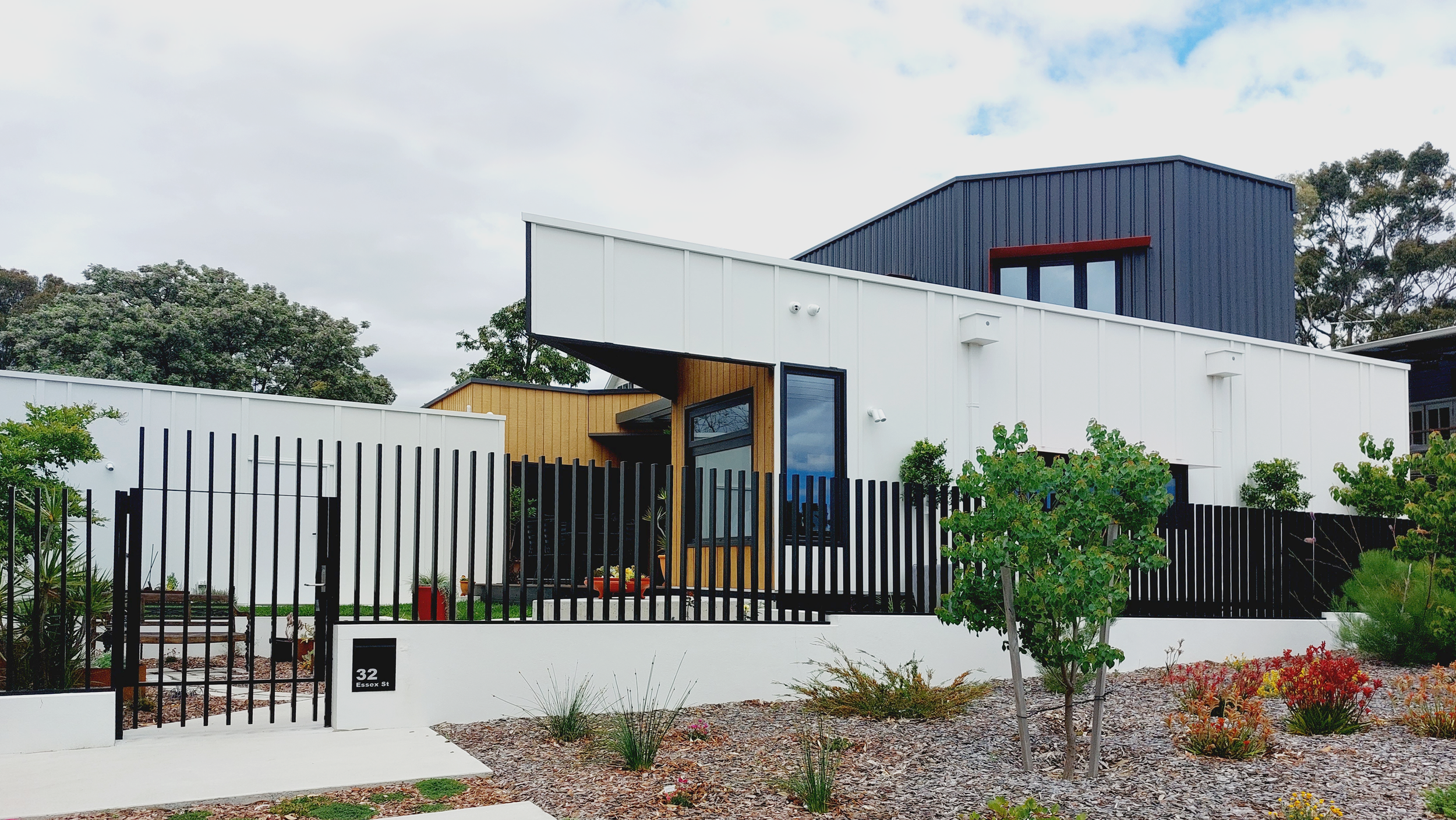
Good medium density design starts from a completely different premise. It begins with the street — creating a built edge that contributes positively to the neighbourhood, with genuine landscaping, human-scale proportions and an architecture that belongs to its place. It provides real natural light and genuine outdoor space to every dwelling. It separates communal and private space thoughtfully, allowing residents to have genuine privacy while sharing amenity.
At the building scale, good medium density design applies exactly the same principles as good single-family home design — passive solar orientation, natural ventilation, quality materials, considered spatial flow. The fact that a building houses four families rather than one does not reduce the obligation to design it well. If anything, it increases it.
The performance opportunity
in medium density housing
One of the most underexplored opportunities in Perth's medium density sector is the application of high-performance and Passive House design principles. Most medium density housing in Perth is built to minimum 7-star NatHERS compliance — the same floor as detached housing — which means residents of these dwellings end up with the same comfort problems and energy bills as occupants of standard houses, compounded by shared walls and often compromised natural light.
But medium density housing has a structural advantage for high-performance design: shared walls. Townhouses and apartments share floor, ceiling and wall surfaces with adjacent dwellings, dramatically reducing the exposed building envelope compared to a detached house. This means the cost premium for achieving high-performance or Passive House standards is proportionally lower per dwelling — the insulation, glazing and ventilation system upgrades are spread across a smaller envelope area per person.
A medium density development built to Passive House principles delivers genuinely comfortable, healthy, low-energy homes at a cost premium that is more achievable per dwelling than in a detached house. It also commands a genuine market premium — energy-efficient dwellings with consistent indoor temperatures, clean air and low running costs attract better tenants and higher resale values in Perth's increasingly informed property market.
Perth's planning environment
is finally catching up
The good news is that Perth's planning framework is beginning to create the conditions for better medium density development. The State Government's Perth and Peel @ 3.5 Million planning framework, updated R-Codes provisions and new infill housing policies are progressively making medium density development more achievable in established suburbs.
Updated R-Codes now allow smaller lot sizes, reduced parking requirements near train stations, and clearer pathways for duplex and grouped dwelling development across Perth's middle and inner ring suburbs. Suburbs like Bayswater, Bassendean, Midland, Inglewood, Victoria Park, Fremantle, Leederville and surrounding areas now have genuine infill potential that would have been difficult to realise five years ago.
This creates real opportunity for Perth landowners with larger blocks in established suburbs — the question is no longer whether medium density development is possible, but whether it is designed well enough to add genuine value to the site, the street and the neighbourhood.
Studio Origami's approach to medium density: We design medium density housing with the same care and intention we bring to individual homes — starting with the street presence, prioritising natural light and outdoor space for every dwelling, and applying passive solar and high-performance principles throughout.
If you own a larger Perth block and are considering subdivision and infill development — from a simple duplex to a more ambitious courtyard housing scheme — a strategy session is the right place to start. We can help you understand what's possible, what it will cost, and whether the numbers make sense for your specific site.